

Why you need to widen your doorways
This is the HTML version of the article that originally appeared in Business Voice magazine.
EU accessibility rules are putting the failures of UK business websites in plain sight, writes Clive Loseby, founder of Access by Design
Imagine you own a shop and the doorway is too narrow for a wheelchair user. You widen the doorway, and of course, the wheelchair user can now get through. Something else has happened too. A parent with a pram, someone carrying luggage, someone using crutches, or a delivery driver with both hands full will all find that doorway easier to use.
This is the heart of website accessibility: when you make access easier for disabled people, you make it easier for everyone, and you remove barriers between customers and sales.
The law has changed
For years, accessibility has been treated as an optional, “nice-to-have” extra. Something ethical and inclusive; something that should matter, but somehow keeps falling down the list.
The European Accessibility Act came into force on 28 June 2025. It covers products and services, but for many UK businesses the greatest risk sits in one obvious place: their website. A building is tied to one location, so if you run a workplace in France, someone has to be in France to use it. Your website is different. It can be visited by anyone, including customers in the EU and the people enforcing EU accessibility rules.
Does this sound familiar? GDPR began as EU legislation, but changed how organisations around the world handled personal data. The European Accessibility Act will have the same kind of impact on digital accessibility and like GDPR, it will take time, but it is inevitable.
Evidence that’s easy to see
The problem for UK-based businesses is visibility. Your website is public and can’t be hidden in a filing cabinet or behind a reception desk. It can be checked instantly by customers, competitors, campaigners, lawyers and regulators. If your website is inaccessible, the evidence is sitting there in plain sight.
Written evidence to Parliament suggests that up to 400,000 UK businesses may fall within scope because of digital trade with EU customers. Yet most have probably never heard of it. At the time of writing, I could find no clear UK government guidance for UK businesses affected by the European Accessibility Act. Although micro-enterprises providing services are often exempt from the EAA, all UK business websites are covered by the Equality Act 2010. Inaccessibility still costs money.
This is the law. Your website is public. Disabled people and their households have an estimated spending power of £274bn a year in the UK. If they cannot use your site, they will go elsewhere
Four steps to take now
- Get an accessibility audit
Many businesses start by using a software check, which can be useful, but it only finds some of the issues. It cannot tell you whether a disabled person can actually use your website. A proper manual audit goes further. It explains what the issues are, how serious they are, who they affect, and what needs to happen next. - Publish a compliant accessibility statement
This should explain the known issues, what you are doing about them, and how people can contact you if they need help. - Be careful with quick fixes
AI tools and accessibility widgets often promise to solve accessibility issues. Unfortunately, they usually fix only a small proportion of the problems, and may even make your website less accessible. They cannot replace proper testing, proper code or human judgment. According to WebAIM, 95.9% of the top one million home pages had detectable Web Content Accessibility Guidelines (WCAG) failures in 2026. This is because most teams were never taught how to build accessibly. - Test using people with disabilities
The only way to truly know whether people with disabilities can use your website is to involve them in testing it. My team includes visually impaired screen-reader users, someone with a hand disability and a tetraplegic tester who uses face-tracking software. We record their testing, because their lived experience helps businesses understand why accessibility matters, not just what needs fixing.
All you are doing is making your doorway wider. Once a web team learns how to do that properly, they do not forget. That is the compound effect.
Change the world, one website at a time.
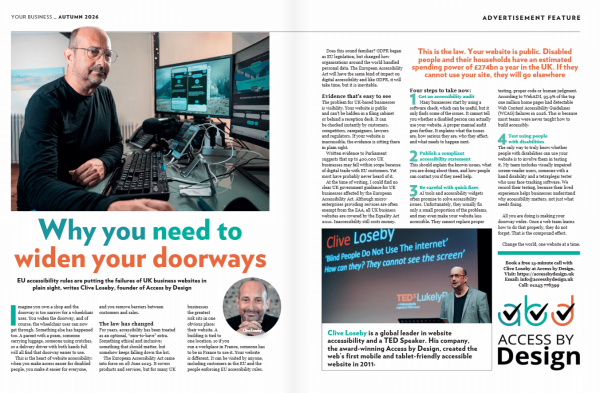
Clive Loseby is a global leader in website accessibility and a TED Speaker. His company, the award-winning Access by Design, created the web’s first mobile and tablet-friendly accessible website in 2011.
Book a free 15-minute call with Clive Loseby at Access by Design.Visit: https://accessbydesign.uk
Email: info@accessbydesign.uk
Call: 01243 776399



Would you like to speak with people
who understand inclusive web design?
Whether you are planning a new website, reviewing an existing platform or trying to understand your accessibility obligations, we would love to help.
Please get in touch to discuss your project, accessibility goals or digital challenges.