

Digital accessibility requirements: what happens before the audit?
I have worked in website accessibility for more than 20 years, and during that time Access by Design has worked with organisations across the public, private and third sectors, including the NHS.
Much of that work happens after a website, system or digital service already exists.
We carry out an accessibility audit, identify barriers and work with the organisation and its developers to understand what needs to change. That work matters enormously, but over the years I have become increasingly interested in something that happens much earlier.
What happens before something is bought in the first place?
Digital accessibility requirements do not suddenly become important when somebody commissions an audit. If an organisation is procuring a website, patient portal, booking system, app or other digital service, decisions made during procurement can have consequences for accessibility long before a user ever encounters it.
That raises some interesting questions.
How is accessibility considered when requirements are drawn up? What is expected from suppliers? Is accessibility tested or verified against, for example, WCAG 2.2 AA? Who within an organisation has responsibility for it? What happens after a digital product has been purchased?
These aren't questions to which I wanted to assume I knew the answers.
Looking at the evidence
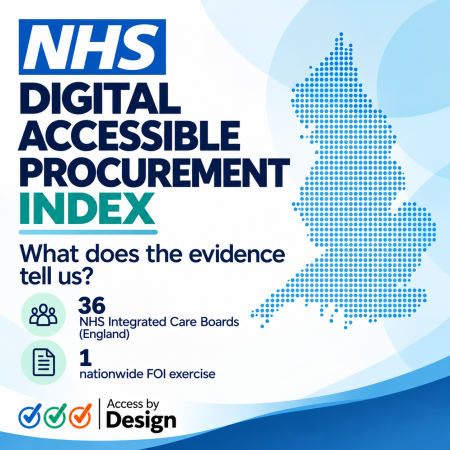
That is why I have begun a nationwide Freedom of Information exercise looking at how NHS Integrated Care Boards address digital accessibility within commissioning and procurement.
FOI requests have been sent to 36 NHS Integrated Care Boards across England, asking a consistent set of questions about their processes.
Responses are now coming in.
At this stage, I deliberately don't want to start drawing conclusions from them. It would be very easy to pick an interesting response, write an article about it and inadvertently create a narrative before we have enough evidence to know whether that narrative is justified.
I'd rather wait.
Once the responses are complete, we will look at them collectively and ask a much more useful question:
What does the evidence actually tell us?
The NHS Accessible Procurement Index
The result will become the NHS Accessible Procurement Index, an evidence-led examination of how digital accessibility is considered within NHS commissioning and procurement.
This isn't intended to be a league table designed to embarrass organisations, nor are we starting with an assumption that accessibility is being handled badly.
If we find examples of good practice, I want to highlight them. If we find common gaps, I want to understand them. If different organisations have found different ways of addressing the same problem, there may be lessons worth sharing.
Ultimately, digital accessibility requirements are about people.
The earlier accessibility is considered, the greater the opportunity to make sure that the digital services people depend upon can actually be used by everyone.
For now, the research continues.



Would you like to speak with people
who understand inclusive web design?
Whether you are planning a new website, reviewing an existing platform or trying to understand your accessibility obligations, we would love to help.
Please get in touch to discuss your project, accessibility goals or digital challenges.